CHI SRC 2026
April 18th, 2026 by Michelle Star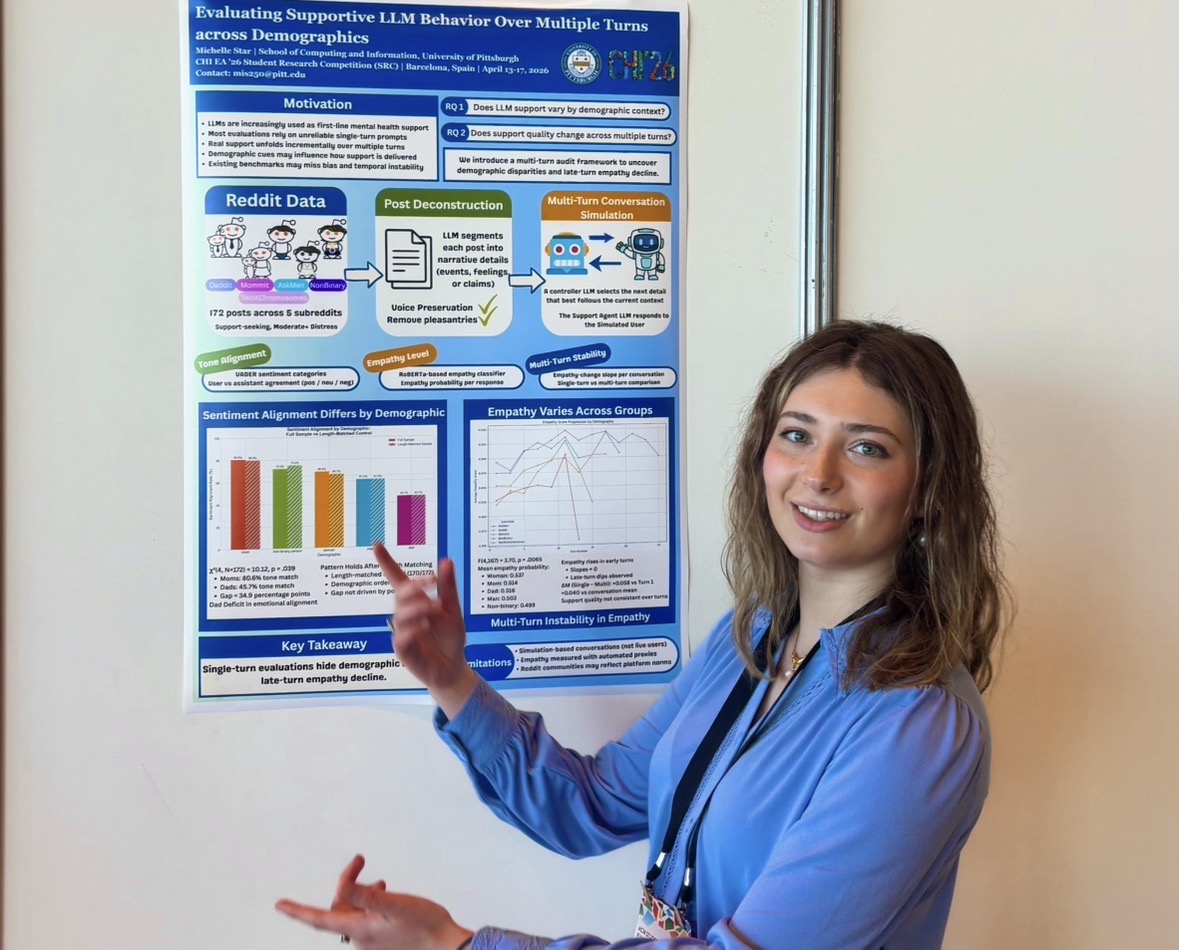
From Pittsburgh to Barcelona: My Research at CHI 2026
April 2026
This spring I traveled to Barcelona, Spain to compete in the Student Research Competition at ACM CHI 2026, the premier international conference in Human-Computer Interaction. I was selected as 1 of 12 students internationally and 1 of only 6 undergraduates. Below is a reflection on my research and the experience.
My story in the news: SCI undergraduate researcher accepted into competitive international ACM Student Research Competition
The Research
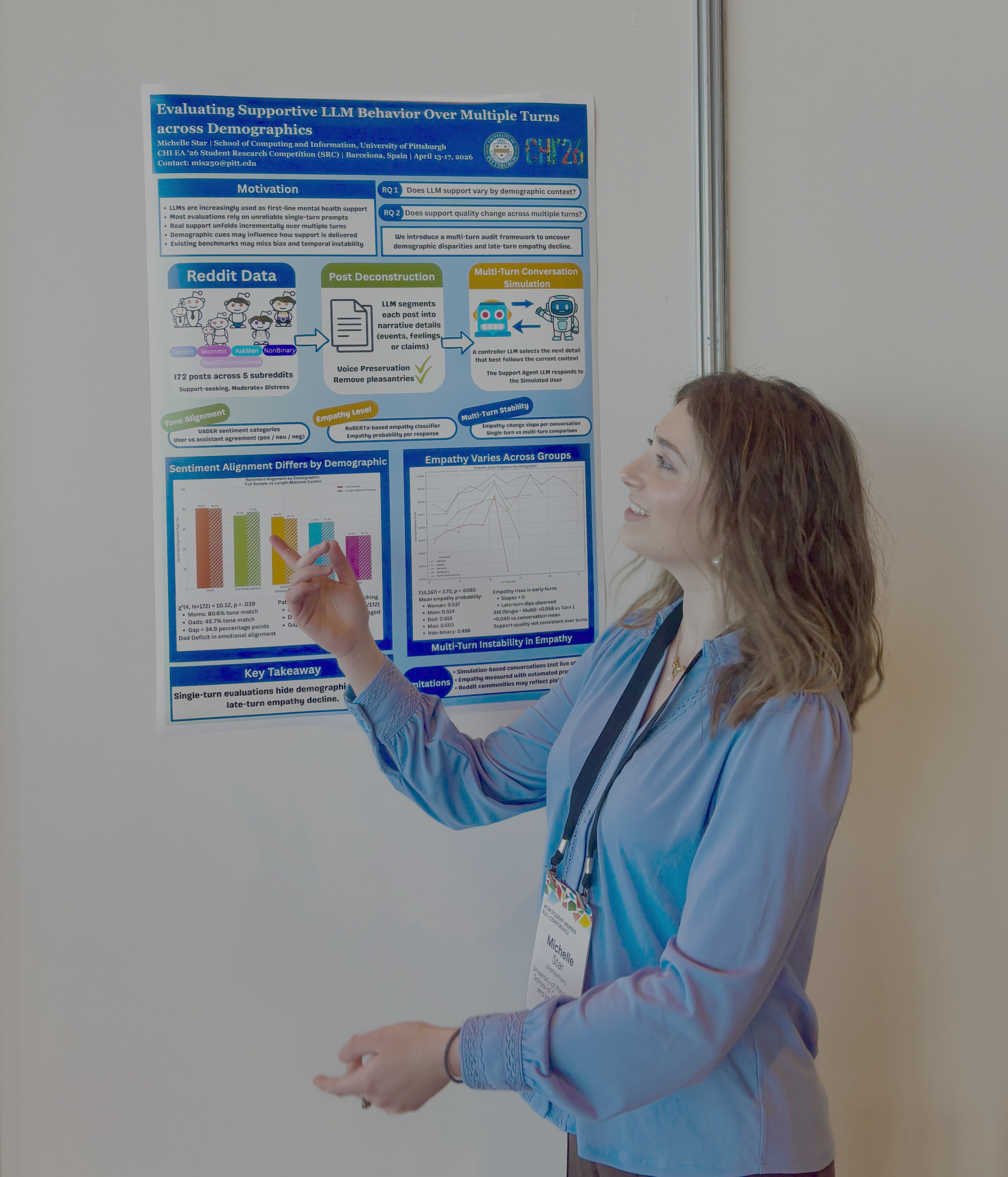
My paper is “Evaluating Supportive LLM Behavior Over Multiple Turns across Demographics” — you can read it here.
People are increasingly turning to AI chatbots for emotional support because they offer a fast, accessible, and low-barrier option. My research began with a gap I saw in the current literature on evaluating LLMs for emotional and mental health support. Existing studies have found that AI chatbots can be highly empathetic and effective in supportive settings, with some even suggesting that chatbot responses are perceived as more helpful than human ones. However, these evaluations are often based on single-turn interactions, where one message receives one response and which is then graded.
Real-world emotional support conversations with AI are multi-turn, with conversations unfolding back and forth over time. People do not present their problems all at once, wrapped up in a neat package. Instead, they open up gradually, revealing context and emotional details piece by piece. Research has also found that LLMs can form a mental model of the user and respond differently based on demographic attributes such as age and gender, which raises important questions about whether certain groups receive lower-quality responses. It was important to me to evaluate supportive LLM behavior across different demographics to examine whether support quality may be biased or unfair in certain community contexts.
To explore this, I developed a multi-turn simulation framework designed to better reflect how real users seek support. I simulated conversations in which a user revealed pieces of support-seeking narratives over a conversation, while a supportive assistant LLM responded. These support-seeking narratives were derived from a dataset of Reddit posts from demographic-specific communities, including r/Mommit, r/Daddit, r/AskMen, r/TwoXChromosomes, and r/NonBinary. Those community spaces provide rich real-world examples of how people ask for social support online. I evaluated the model’s responses using sentiment analysis and an empathy classifier to measure how well the model matched emotional tone and whether it maintained supportive behavior across turns.
What I Found
The biggest finding in my research was the “Dad Deficit.” When the AI responded to posts from mothers, it matched their emotional tone 80.6% of the time. For fathers, that number dropped to 45.7%, which was a statistically significant difference. That gap suggests that supportive AI may not respond equally well across demographic groups, which is especially concerning when people are turning to these systems in vulnerable moments.
I also found that supportive behavior can weaken over the course of a conversation. Empathy tended to dip in later turns, meaning the quality of support was not always sustained as the interaction continued, which is consistent with findings of “contextual fatigue” displayed in multi-turn conversations. This is important because it highlights a limitation in the way many AI assistants are currently evaluated. Testing only one prompt and one response causes researchers to miss degradation that only emerges over time.
Overall, these findings matter because LLMs are increasingly being used in emotionally sensitive contexts. If certain groups are quietly receiving less aligned or less consistent support, that raises a serious fairness concern. My research shows that we need more realistic evaluation methods to better understand how these systems behave in practice.
Getting There
It’s an interesting challenge to prepare for something as grand as CHI. I did my research beforehand, but no amount of internet searches, Reddit threads, or advice came close to capturing what it was actually like.
On the research side, I created a poster presenting my work as well as practiced my elevator pitch. I studied the conference schedule to figure out which paper presentations I wanted to see and which researchers I wanted to meet. Then there’s the travel component of attending an international conference, including booking flights and a hotel in Barcelona. On top of it all I was finishing my senior year, but it was absolutely worth it.
Being There
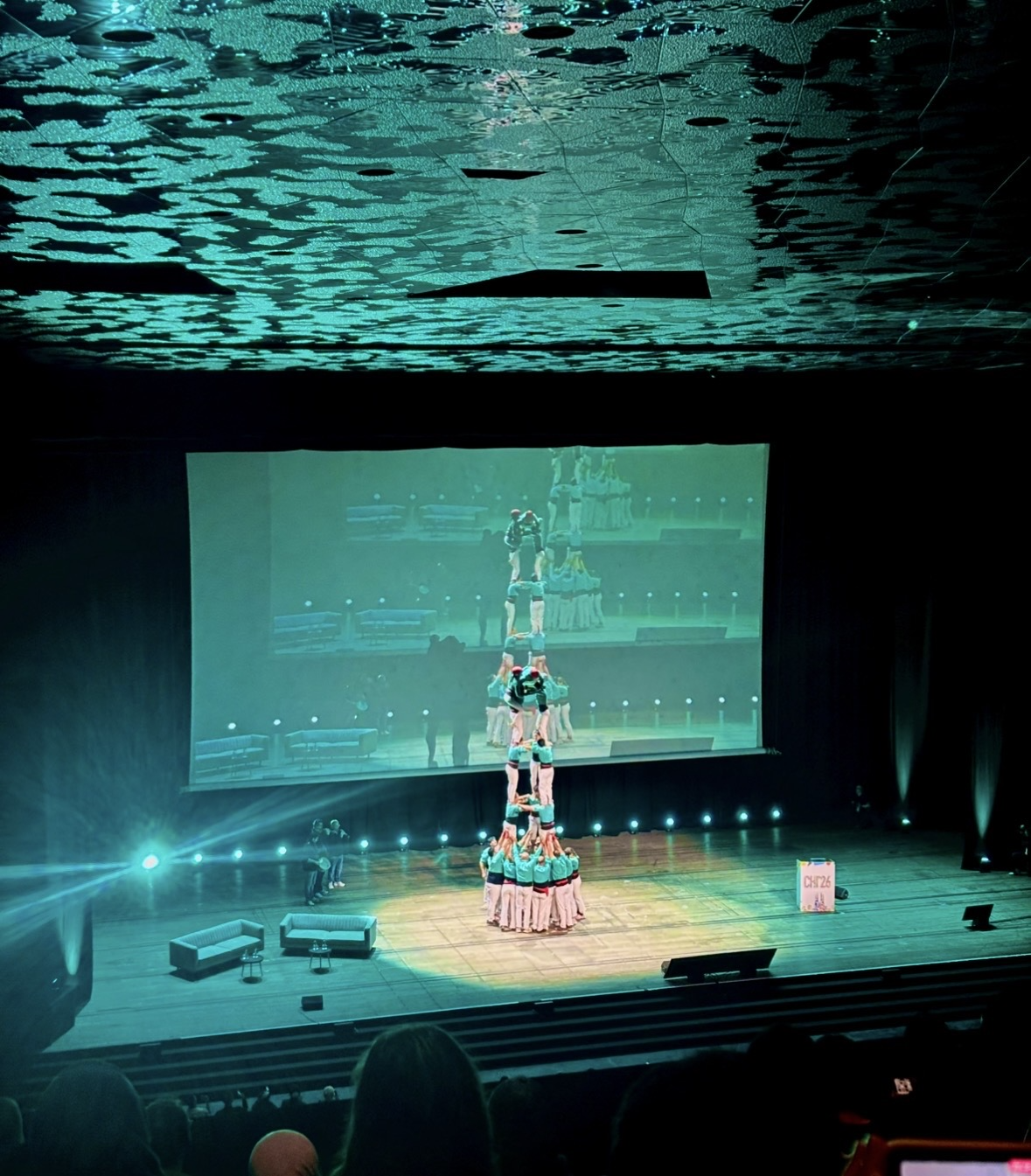
It’s electric. There are over 5,000 people there, all coming from completely different backgrounds and corners of the world, brought together by this shared passion for human-centered technology. It’s an extrovert’s dream, and there is always someone nearby ready to have a genuinely stimulating conversation. You can be in the same room as the top researchers and professors from around the world, and what surprised me most was how incredibly humble and easy to talk to they are. A couple of times I was mid-conversation with someone before realizing they were actually a prominent professor in the field.
The days are nonstop packed with papers, workshops, and meetups, all back-to-back. Genuinely though, some of my best conversations and connections happened in the in-between moments: on the green outside the venue, at coffee breaks, or lingering after sessions ended.

What I Learned
I learned so much at the conference, from new scientific findings and cutting-edge methodologies to groundbreaking research across an incredible range of topics in HCI. People there were working on large-scale societal issues in women’s healthcare, designing new sensory taste experiences, and building prosthetics that re-think the human form. The breadth of work being done was incredibly eye-opening.
What stuck with me most, was that there is a real community of people behind all this amazing research. People who have devoted their minds and hearts to this work. Seeing how eager everyone was to spend their time walking you through what they’d built, and then turning around and genuinely wanting to know about you and your work, was the part that stayed with me. It made the research feel human in a way that is hard to grasp from reading papers alone.
What It Meant
This was the highlight of my undergraduate journey, and it came at the right time. As I prepare to graduate this April at the honors commencement and receive my Bachelor of Philosophy (BPhil), the experience felt especially meaningful because it marked a major milestone in my growth as a researcher.
At this early stage in my academic journey, having the opportunity to attend a conference, connect with peers from diverse backgrounds, and meet future friends and collaborators has strengthened my sense of identity in the field. Being surrounded by people who shared that same passion for research put a great deal into perspective, especially the resilience and hard work required to pursue this path.
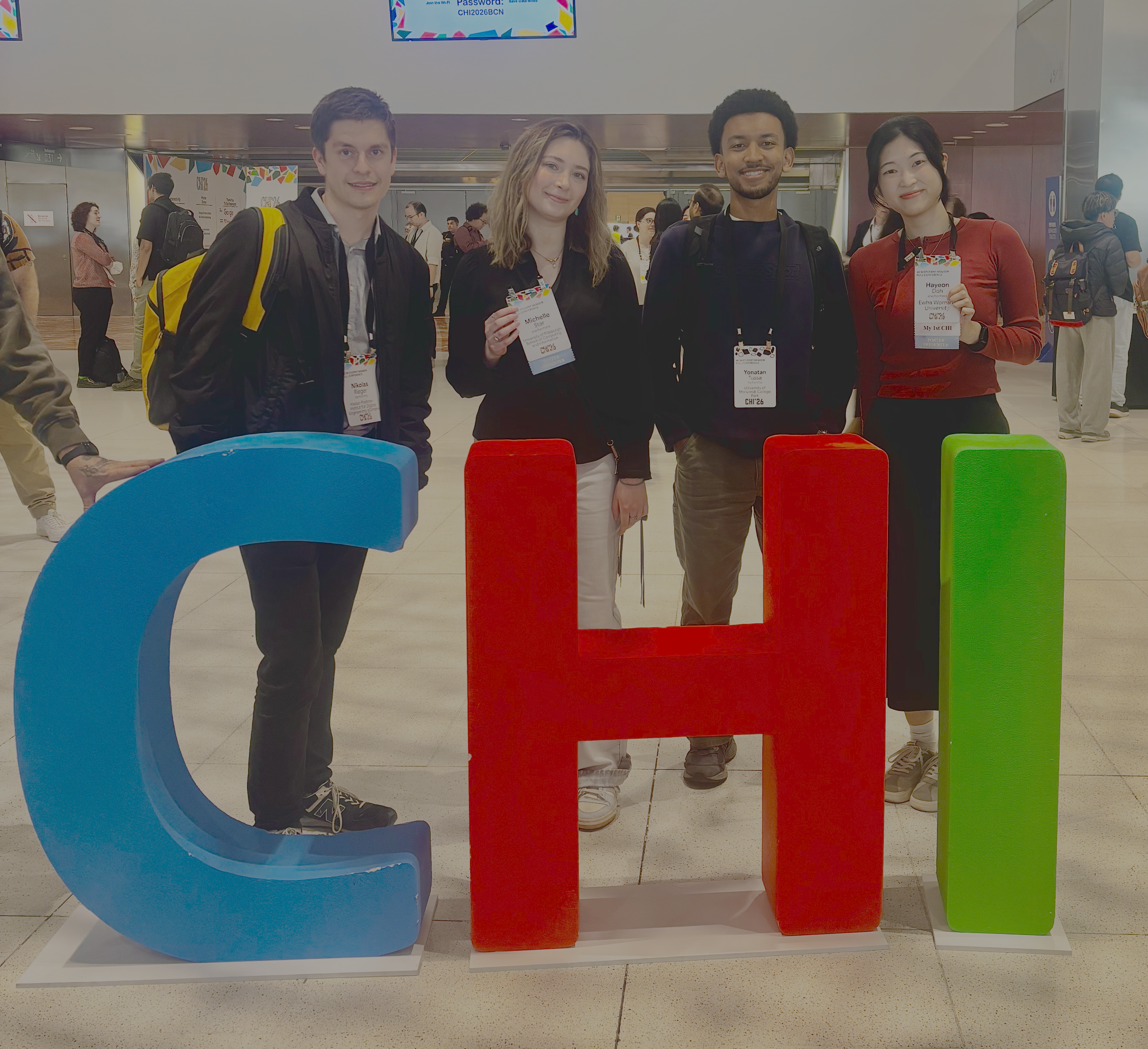
I met master’s students, PhD researchers, industry scientists, and professors who gave me advice and perspectives I know I’ll carry with me. Seeing how vibrant and welcoming the HCI community is, I was honored to be able to contribute to it as an undergrad.
The conference opened my mind to potential new research avenues I may want to pursue in the future and left me feeling excited about what comes next. More than anything, it gave me a sense of clarity and reminded me what all of this work is for.
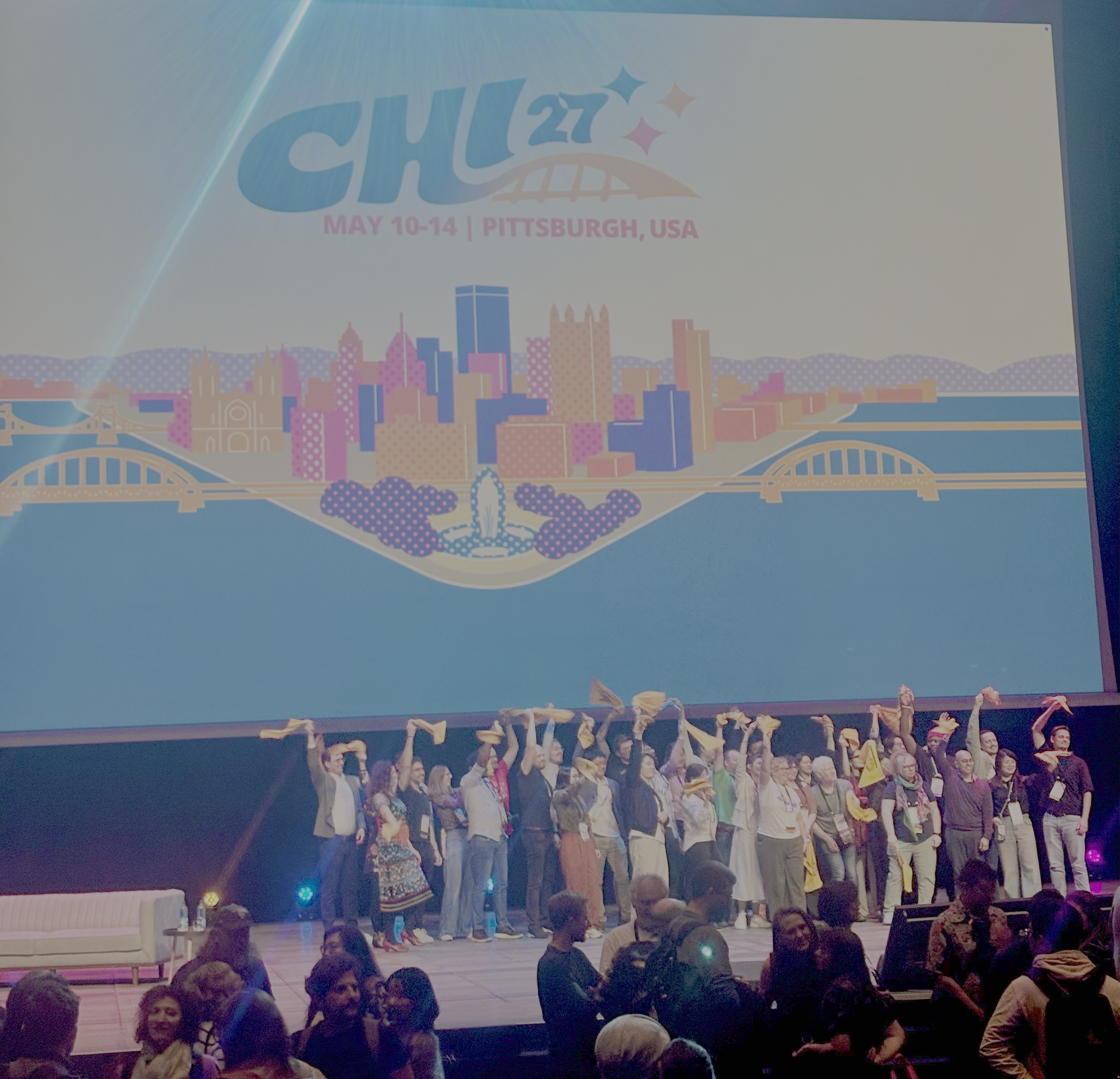
See you next year in Pittsburgh :)
Read the paper: Evaluating Supportive LLM Behavior Over Multiple Turns across Demographics